
How can I help with math at home if I’m not a math person?
Start with how you talk about math. Try not to say “I was never good at math” in front of your child. Kids copy our attitudes, and math is a skill that grows with practice, not a talent some people simply lack. You also do not need to know every method. Schools today often teach several ways to solve the same problem, and they may look different from how you learned. When a method is new to you, ask your child to teach it to you. Explaining a step out loud is great practice. If you are both stuck, ask the teacher for a worked example to keep at home.
Habits 1 and 2: Count, measure and talk about money every day
The easiest math happens in normal life. With K–2 children, count stairs, grapes or cars at a red light. Ask “How many forks do we need if Grandma comes too?” In the kitchen, let them fill measuring cups, which is a first taste of fractions. At the store, older kids can compare two prices, add up a few items or work out the change. Grades 3–5 can figure out how long until dinner, or how many days until a birthday. These short moments show children that math is useful and not just something on a worksheet. A few minutes a day adds up over a school year.
Habits 3 and 4: Ask “How did you get that?” and play number games
When your child answers a math question, right or wrong, ask “How did you get that?” This builds reasoning and helps you spot a mix-up early. Praise the thinking, not only the answer. Games help too. Card games, dice games and board games that use counting, adding or planning ahead all build number sense without feeling like homework. Even a simple game of War, where each player adds two cards and the bigger total wins, gives young children a lot of fast addition practice. For older children, games that need planning and strategy train patience and step-by-step thinking.
Habits 5 and 6: Practice math facts in short bursts and read the clock
Quick recall of addition, subtraction and multiplication facts frees up your child’s brain for harder problems. Five minutes a day works better than one long session on the weekend. Use flash cards in the car, or call out a fact while dinner is cooking. Keep it light and stop before it turns into a struggle. Telling time is another skill that slips through the cracks. Keep a clock with hands somewhere at home and ask your child to read it: “What time is it now? We leave in 15 minutes. What time will that be?” Calendars help with counting days and weeks too.
Habit 7: Keep homework calm and let mistakes happen
Set a regular time and place for math homework, and stay close by without hovering. For word problems, teach a simple routine: read it twice, underline the question, then draw a quick picture. Many children who “can’t do word problems” really struggle with the reading or the setup, not the math. Let your child make mistakes and find them. A mistake that gets fixed is often where the real learning happens. If homework turns into tears most nights, take a break and come back to it later, and let the teacher know where things went wrong.
When should I ask for a math tutor?
Every child struggles with something now and then. The time to get help is when a pattern lasts. Signs include being stuck on the same skill for several weeks, still relying on counting for most simple facts by 3rd grade, falling grades or teacher notes about math, and strong worry or tears whenever math comes up. Another sign is when you no longer feel able to help without arguments. Talk to your child’s teacher first, since they see your child’s work every day. A tutor can then give short, regular sessions that fill gaps and rebuild confidence before the next topic builds on the old one.
Math tutoring at Grand Educational Center
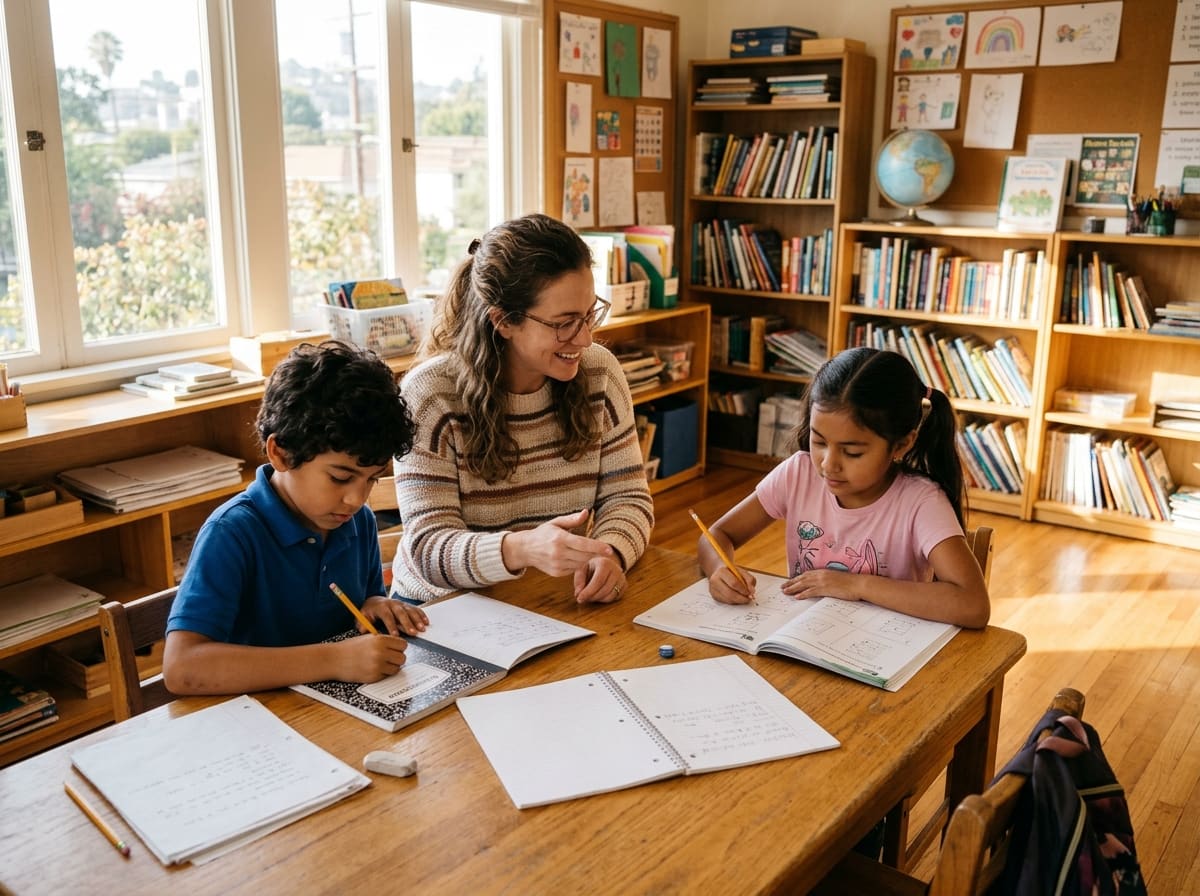
At Grand Educational Center, math help is part of every weekday. From 2:30 to 4:00 PM, tutors review each child’s school assignments and help with Common Core math, reading and writing for Grades K–7. They also give 1-on-1 practice before upcoming tests. Working beside a tutor, children can show each step, so small mix-ups get caught early. Some children also enjoy our chess classes, which practice patient, step-by-step thinking. To talk about your child’s math needs, book a visit or call (747) 236-8888. We are at 725 E Broadway in Glendale, open Monday to Friday from 1:00 to 10:00 PM.